
Tre visioni di Barcellona
BARCELLONA OSPIZIO DEI POVERI
28 maggio - 2 giugno 2006
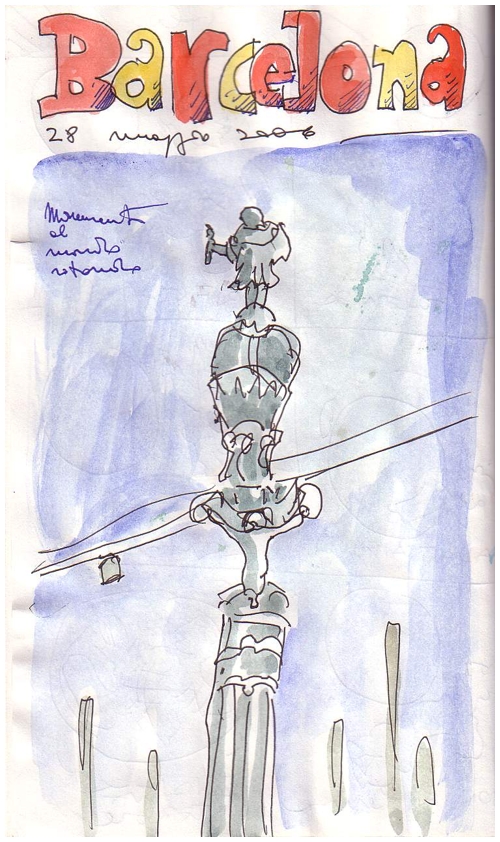
Tutti i disegni sono tratti dal moleskine n. 26 © by Massimo Presciutti Siae / Arsny
Come ragazza lazzarona che può permettersi di vestirsi a caso talvolta Barcellona presenta orgogliosa la sua faccia sfrontata, capelli neri coda di cavallo, segui i suoi passi poi cambi strada e la ritrovi sorridente che plana l'ascensore in labirinti auriculari di palazzi dove stanze regali si alternano a stamberghe di topi e camere di tortura dove la danza che sfiora la miseria e sparge bellezza è l'unico rapporto possibile. Il sole sorge ancora su questa città, ma una pioggia sottile scioglie i muri e ci lascia poveri, cullati dal peculiare brusio incessante.
Mi siedo a un tavolino di uno dei bar in Plaça Universitat, un cameriere mi porta un caffé, prendo il moleskine, disegno le ragazze che passano cercando di cogliere l'attimo in cui la loro marcia è perfettamente intonata ai segni architettonici che fluenti si aprono infiniti sipari, una donna straniera si siede di fronte e mi saluta.
- "È stata violenta la rivoluzione?" le chiedo.
- "No, la gente è scesa in piazza, a Sofia, a Gabrovo, a Veliko Tarnovo, a Plovdiv e in altre città"
- "Io sono un artista"
- "Io sono democratica"
- "Vuoi dire niente caste?"
- "Niente"
- "E che fine hanno fatto... loro?"
- "Nessuna fine, hanno i loro partiti, piccoli"
La pioggia rende trasparenti i passanti, le coppie, i gruppi di turisti sparsi di Barcellona sincera, la cui vita profonda è assicurata da una montagna d'acqua che come un cuore di cristallo la alimenta, è la Casa de les Aigües de Montcada i Reixac. "Montagna d'acqua", in catalano "montcada", è il comune di Montcada, è lì la nostra scuola partner. La raggiungiamo in metrò, ricco di invisibili borseggiatori, già previsti in "Art of living". I tre anni del nostro Progetto Socrates Comenius hanno scandito un percorso verso la povertà, "Art of living" come pietra miliare in mezzo a un torrente che se ne torna a riva grano a grano (vecchio proverbio indiano), niente di materiale resta e per questo, in quanto niente, torna in mano ai poveri. Il niente è la ricchezza che nessuno potrà mai rubare, neanche gli abili tagliaborse dei metrò di BCN. Ma i libri, i CD, i lavori dei ragazzi, le immagini, i cibi... non sono cose materiali? Si, ma non hanno bisogno di essere collegate al Progetto, ovvero a ciò che è venuto prima di loro. Certo dispiace. Scrive Gertrud appena tornata a Klaus nel Vorarlberg: "It was wonderful to meet you again and I hope it will not be the last time". Noi possiamo incontrarci quando vogliamo ma il Progetto Socrates Comenius "Art of living" è stato l'incontro felice tra arte e politica, tra tolleranza e rifiuto, tra armonia e adattamento, tra non violenza e solidità interiore. Personalmente non ho dubbi che lavoreremo ancora insieme. Ma non dipende da noi.
Dipende da noi invece tutto quello che viene prima del Progetto: il lavoro con i ragazzi (che è studio, esposizione, ricerca), la filosofia del "lifelonglearning", l'isolamento dello studio, il pacifico confronto perché tali isole siano possibili pur nel flusso spazio temporale.
Ho speso più per i caffé che per i quotidiani e la cultura. Strano ma è andata proprio così.
- "Dove andate al mare quest'estate?"
- "Mar Nero."
- "Quanto dista il Mediterraneo da Krumovgrad?"
- "Ottanta chilometri, anche il Mar Nero dista ottanta chilometri. I greci però non fanno passare i bulgari al confine, ci sono problemi di clandestini e allora per i greci sono tutti uguali i bulgari."
- "Quasi una proiezione del comunismo fuori orario storico"
Martedì 30 maggio, free afternoon, mi ritrovo sulla spiaggia a Barcelloneta, posto che puoi raggiungere camminando quasi seguendo l'indicazione di Cristoforo Colombo che enorme in fondo alla rambla si erge come munumento alla rotondità del mondo. Il vento dal mare sfiora le palme e apre i polmoni, penso ai veloci sorrisi di BCN, alla cautela con cui il secondo punto di "Art of living", il Rifiuto, fu accettato a Montcada i Reixac. Nel primo dei primi tre volumi la parola rifiuto non sta da sola: "Rifiuto dell'intolleranza" si legge e ciò va di pari passo con la tolleranza di cui al primo punto, anche lei accompagnata da qualcos'altro: "Tolleranza al rifiuto". Ricordo che negli altri due volumi i punti sono presentati in copertina così come sono: Adattamento, Armonia, Non violenza, Solidità interiore. In effetti in una e.mail pubblicata Isabel parla della profondità interna al luccichio della tolleranza: "(...) the nature is angry (hurricanes, volcanoes, floods, earthquakes), the natures scares us, but it is alive and We have to care of it, to respect it".
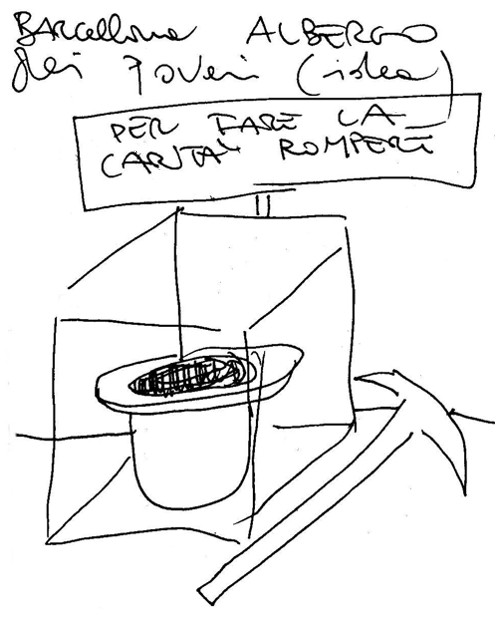
Anche la povertà è un cataclisma che merita interesse e rispetto. Essendo la povertà nemica del genere umano andrebbe combattuta fino ad eliminarla (senza eliminare i poveri). Per eliminarla non va alimentata con la carità. Vanno favorite invece quelle imprese e quelle scoperte che rendano il mondo migliore. La classe dirigente ha il dovere di permettere tali imprese e scoperte e e di non ostacolarle in alcun modo. La carità è ammissibile solo eccezionalmente, il classico cappello del povero, rovesciato e pronto ad accogliere le monete dei passanti, dovrebbe essere per legge messo sotto vetro con accanto una targhetta: "Rompere solo in caso di reale bisogno".
Prima parte: Barcellona archivio della cortesia
Seconda parte: Barcellona albergo dei forestieri
Massimo Presciutti, 7 giugno 2006
(Fine della terza ed ultima parte di "Le tre visioni di Barcellona")
BARCELONA POOR'S ALMSHOUSE
From May 28th to June 2nd 2006
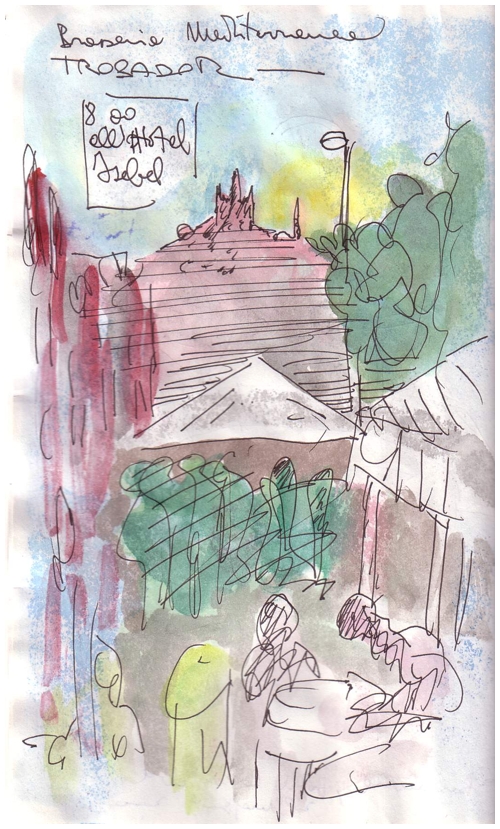
All the drawings are taken from the moleskine n. 26 © by Massimo Presciutti Siae / Arsny
Like a scoundrel girl that can afford to dress out of the hat sometime Barcelona shows proud her impudent face, dark hair horsetail, you follow in her's footsteps then you take another road and you meet again smiling her planing the lift in the auricular labyrinths of the palaces where a royal rooms alternate with a rat's tips and a torture chamber where the dance kissing the misery and spreading the beauty it's the only possible contact. The sun also rises on this city, but a thin rain melts the walls and it leaves us like a needy, rockeds by the peculiar unceasing hum.
I sit down at the table of one of the bar to the Plaça Universitat, a waiter brings me a coffee, I take the moleskine, I draw the passing girls looking for to seize the moment where them marching is perfectly in tune with the flowing architectural signs opening up like an unlimited curtains, a foreign woman takes a seat in front and say hello to me.
- "Was been the revolution violent?" I ask her
- "No, the people goes out into the streets, in Sofia, in Gabrovo, in Veliko Tarnovo, in Plovdiv and in other city"
- "I'm an artist"
- "I'm a democrat"
- "You mean no caste system?"
- "Nothing"
- "And what have become of... them?"
- "They live again, they have their parties, little parties"
The rain makes transparent the passers-by, the couples, the groups of tourists in dribs and drabs of a true Barcelona, whose deep life is insured by a mountain of water that like an heart of crystal nourish her, it's the Casa de les Aigües de Montcada i Reixac. "Mountain of water", in Catalan "montcada", it's the Montcada town, it's there our partner school. We get to it by underground, rich in an invisible pickpockets, already predicted in "Art of living". The three years of our Socrates Comenius Project have articulate a way towards the poverty, "Art of living" like a milestone n the middle of a torrent that it comes back aloft crumbled (old Indian proverb), nothing about the material world it remains and that's why, as nothing, it comes back under control of the poors person. The nothing is the wealth that noboby will can ever steal, neither the clever pickpocket of the underground of BCN. But the books, the CD, the works by the pupils, the images, the foods... don't they be a material things them? Yes they are, but they haven't need to be linked to the Project, or better to what it's came before them. For sure We vex it. Gertrud write us just arrived to Klaus in Vorarlberg: "It was wonderful to meet you again and I hope it will not be the last time". We can meet when We want but the "Art of living" Socrates Comenius Project has been the happy meeting between the art and the politics, between tolerance and refusal, between harmony and ability to adapt, between non-violence and inner life solidity. Personally, I don't have doubts that We will work together again. But it doesn't depend on us.
It depend on us instead whatever it come before the Project: the work with the children (that's the study, the exposition, the research), the philosophy of "lifeloglearnig", the isolation for stuy, the peaceful confrontation so that these islands these be possible even though in the space - time flow.
I spent more on coffees than on newspaper and culture. It's strange but it went just like this.
- "Where are you going to the sea this summer?"
- "The Black Sea"
- "How far is the Mediterranean from Krumovgrad?"
- "Eighty kilometres, the Black Sea too is far eighty kilometres. But the Greeks don't cross the border to the Bulgarians, they are a problems there about the stowaways, and so for the Greeks are all equals the Bulgarians."
- "As if a projection of the communism after historical hours"
In May 30th on Tuesday, free afternoon, I find myself on the beach in Barceloneta, a place that you can reach on walking as if following Christopher Columbus's lead who colossal in the bottom of the rambla He soars like a monument to the world's roundness. The wind of the sea kiss palms tree and it open the lungs, I think to the fast smiles di BCN, to the caution with which the second point of "Art of living", the Refusal, was accepted in Montcada i Reixac. In the first of the three books the refusal world isn't unaccompanied: "Refusal of intolerance" We can read and it was going in step with with the tolerance whose at first point, accompanied as well anything else: "Tolerance to refusal". I remember you that in the other two books the points are presented on the front cover how points really stand: Ability to adapt, Harmony, Non - violence, Inner life solidity. Actually in a published e.mail Isabel talks about the depth inside of the shimmer of the tolerance: "(...) the nature is angry (hurricanes, volcanoes, floods, earthquakes), the natures scares us, but it is alive and We have to care of it, to respect it".
Also the poverty is a catastrophe worthing interest and respect. Since the poverty is hostile to the human being We have to fight till her suppression (without dispose of the poor). To the liquidation of the poverty We don't have to power the poverty with the charity. We have to encourage whereas the enterprises and the discoveries making the better world. The ruling class musts to allow such enterprises and discoveries and not obstruct these in no way. The charity is permissible only exceptionally, the classic hat of the poor man, overturned and ready to take the money of the passers-by, should be prescribed by law placed under glass with a little plate: "Shatter only under real necessity".
Since October 2006 - © Massimo Presciutti, Firenze - All Rights Reserved.
